
How to Achieving Tablet Stability with Moisture Management
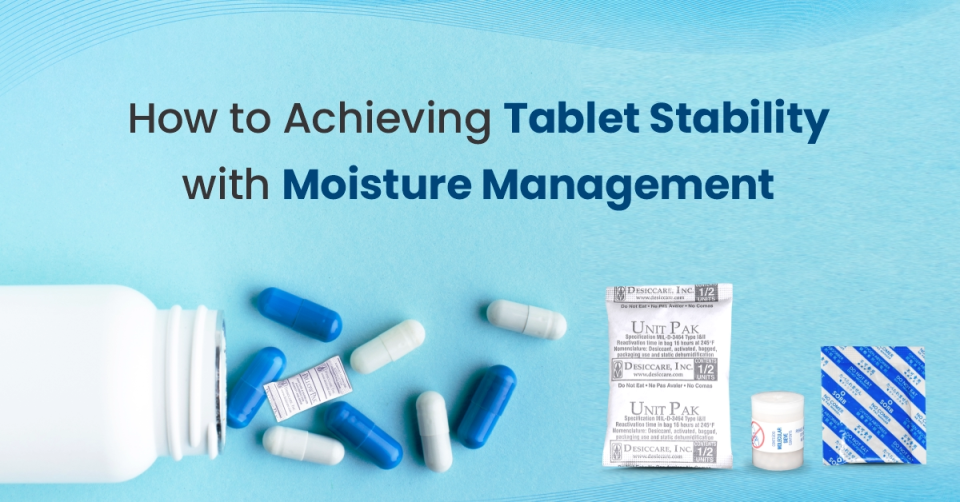
The integrity and efficacy of pharmaceutical tablets are directly linked to their stability. For manufacturers, pharmacists, and ultimately, patients, ensuring that a tablet maintains its intended potency, appearance, and dissolution profile throughout its shelf life is paramount. A tablet’s greatest, yet often silent, enemy is moisture. Uncontrolled humidity is the single largest contributing factor to drug degradation, leading to compromised active pharmaceutical ingredients (APIs), altered physical characteristics, and ultimately, reduced therapeutic effectiveness.
This guide delves into the science of moisture-induced instability and provides a comprehensive, multi-layered approach to moisture management, focusing on best practices in formulation, processing, packaging, and the strategic application of high-performance desiccants the final, critical line of defense.
The Destructive Science of Moisture-Induced Degradation
Moisture poses two primary threats to solid dosage forms: chemical degradation and physical degradation.
Chemical Instability
Water acts as a solvent and a catalyst, accelerating chemical reactions that compromise the API. The most common moisture-catalyzed reactions include:
- Hydrolysis: This is the breakdown of chemical bonds by water. Many common drug classes, such as esters, amides, and lactams (e.g., certain antibiotics and anti-hypertensive), are highly susceptible to hydrolytic cleavage, which renders the drug inactive.
- Oxidation: While often driven by oxygen, the presence of moisture significantly accelerates the oxidative breakdown of many APIs, particularly those with unsaturated bonds.
- Polymerization: In some formulations, moisture can induce API molecules to react with each other, forming larger, therapeutically inert compounds.
Physical Instability
Beyond chemical breakdown, moisture can fundamentally alter the tablet’s structure, affecting its usability and bioavailability:
- Caking and Aggregation: Hygroscopic materials absorb ambient moisture, causing the powder particles to dissolve and re-crystallize, resulting in a hardened, solid mass that cannot be properly dispensed or dissolved.
- Softening or Cracking: The absorbed water can act as a plasticizer for polymer coatings (like film coats), reducing their barrier properties, causing them to swell, crack, or become tacky.6 This affects the tablet’s physical appearance and can lead to premature API release.
- Reduced Dissolution Rate: Changes in crystal structure or particle size due to moisture can drastically slow down how quickly the tablet breaks down in the gastrointestinal tract, directly impacting the drug’s absorption and therapeutic effect.
Layer 1: Control in Formulation and Manufacturing
Achieving stability begins long before the tablet reaches its final packaging. It requires meticulous control over ingredients and the production environment.
Strategic Excipient Selection
The formulation itself can be a major source of instability. Excipien the non-active ingredients often have a greater affinity for water than the API. Manufacturers should prioritize less hygroscopic alternatives:
- Instead of certain forms of lactose, which are notorious for moisture absorption, consider using microcrystalline cellulose (MCC) or specific calcium phosphate grades.
- For coatings, choose moisture-resistant polymers and ensure the application process achieves a uniform, defect-free barrier layer.
Environmental Controls during Processing
Every stage of manufacturing, from blending to compression and coating, must be conducted under strictly controlled humidity conditions.
- Dehumidification Systems: Processing areas must utilize high-efficiency HVAC and dehumidification units to maintain a low and constant Relative Humidity (RH), often below 30% or even 20%, depending on the API's sensitivity.
- Final Drying: Efficient drying techniques (e.g., fluid bed drying) must reduce the residual moisture content of granules and tablets to a predefined, safe level typically measured by Loss on Drying (LOD) before they proceed to packaging.8 This prevents the "sealing in" of destructive internal moisture.
Layer 2: The Imperative of Barrier Packaging
The primary packaging system serves as a physical firewall against external moisture, light, and gases. The choice of packaging material is crucial and is governed by its Moisture Vapor Transmission Rate (MVTR). A lower MVTR indicates superior barrier performance.
- Aluminum/Aluminum Blister Packs: These offer the gold standard in barrier protection, providing a near-zero MVTR, and are the preferred choice for extremely moisture-sensitive drugs.
- Cold-Formed Foil (Alu-Alu): Offers total occlusion and protection but can be more costly and bulky than PVC/PVDC or HDPE bottles.
- High-Density Polyethylene (HDPE) Bottles: The industry standard for bulk tablets, but the integrity of the seal, including the cap, closure liner, and induction seal, is critical to maintaining a low MVTR.
While barrier packaging is essential, no material is perfectly impervious. Over time, or with poor handling, external moisture will eventually permeate the packaging system. This is where the third, most critical layer of defense comes into play.
Layer 3: Strategic Desiccant Application for Dynamic Control
Desiccants are moisture-adsorbing agents intentionally placed within the packaging to actively scavenge any residual or permeating water vapor, thereby lowering the Equilibrium Relative Humidity (ERH) inside the container. This dynamic moisture control is non-negotiable for long-term tablet stability.
Selecting the Right Desiccant Material
The choice of desiccant depends on the required low-humidity level and the conditions of its storage.
- Silica Gel: The most common desiccant, prized for its vast internal surface area. It excels at adsorption across a wide range of humidity, making it effective for general pharmaceutical protection. It is especially effective at moderating humidity in the mid-range (40–80% RH).
- Molecular Sieves (Synthetic Zeolites): These are crystalline aluminosilicates with uniform pore sizes. They exhibit an extremely high capacity to adsorb moisture at very low humidity levels (below 10% RH), making them indispensable for highly sensitive APIs that require bone-dry environments.
- Clay Desiccants (Bentonite): Generally less expensive, but their adsorption capacity can be sensitive to temperature and they are less effective at very low RH compared to silica gel or molecular sieves.
Desiccant Sizing and Placement
Effective moisture management hinges on calculating the correct desiccant dosage the mass of desiccant required to protect the product for its specified shelf life under expected storage conditions. This calculation considers:
- The tablet's initial residual moisture content.
- The MVTR of the packaging material.
- The free air volume inside the container.
- The required target ERH (e.g., 10% RH).
Desiccants are typically placed as canisters (rigid, dust-free containers) or packets/sachets (small bags of desiccant material) inside the primary container. Canisters are preferred in automated high-speed packaging lines due to their robustness, while sachets offer flexibility.
The Role of Desiccant-Integrated Systems
In modern packaging, the desiccant can even be integrated into the closure system (e.g., a desiccant cap) or directly into the packaging material itself (e.g., a desiccant film). These advancements offer improved barrier properties and eliminate the need for an extra insertion step on the packaging line, maximizing efficiency and protection.
Layer 4: Monitoring and Quality Assurance
The final layer is continuous verification through rigorous testing and monitoring.
Water Activity vs. Moisture Content
It is crucial to differentiate between Total Moisture Content (the absolute mass of water in the tablet, measured by LOD or Karl Fischer titration) and Water Activity (aw). Water activity is a better predictor of stability as it measures the available or free water that can participate in chemical reactions. Maintaining a law below a critical threshold (often $0.3$ to $0.5$) is key to arresting degradation.
Stability Testing
Pharmaceutical products must undergo accelerated stability testing (high temperature, high humidity) and long-term stability testing to confirm the moisture management strategy is successful. If degradation occurs during these tests, the formulation, packaging, or desiccant system must be re-evaluated and optimized.
Conclusion
Achieving robust tablet stability with moisture management is not a single-step process, but a strategic system of layered defenses. It begins with intelligent formulation and strict manufacturing controls, is reinforced by superior barrier packaging, and is critically safeguarded by the proper selection and application of pharmaceutical-grade desiccants. By implementing this holistic approach and continuously monitoring water activity, manufacturers ensure that their products retain maximum potency, safety, and shelf life, ultimately protecting the efficacy of the medication and the health of the consumer.
